Have you ever wondered whether you should write die or dye? These two words sound exactly the same, but their meanings and spellings are completely different. So, when it comes to die or dye, which word is correct?
The answer depends on what you mean. Die usually relates to life ending, something stopping, or a single gaming cube. Dye relates to changing the color of something or the substance used to add color. Cambridge Dictionary lists both words with the same pronunciation which explains why they are so easy to confuse.
In this guide, you’ll learn the difference between die and dye, when to use each word, common mistakes, and a simple trick to remember them.
Die or Dye: Which Word Is Correct?
Both die and dye are correct English words, but they are used in completely different situations.
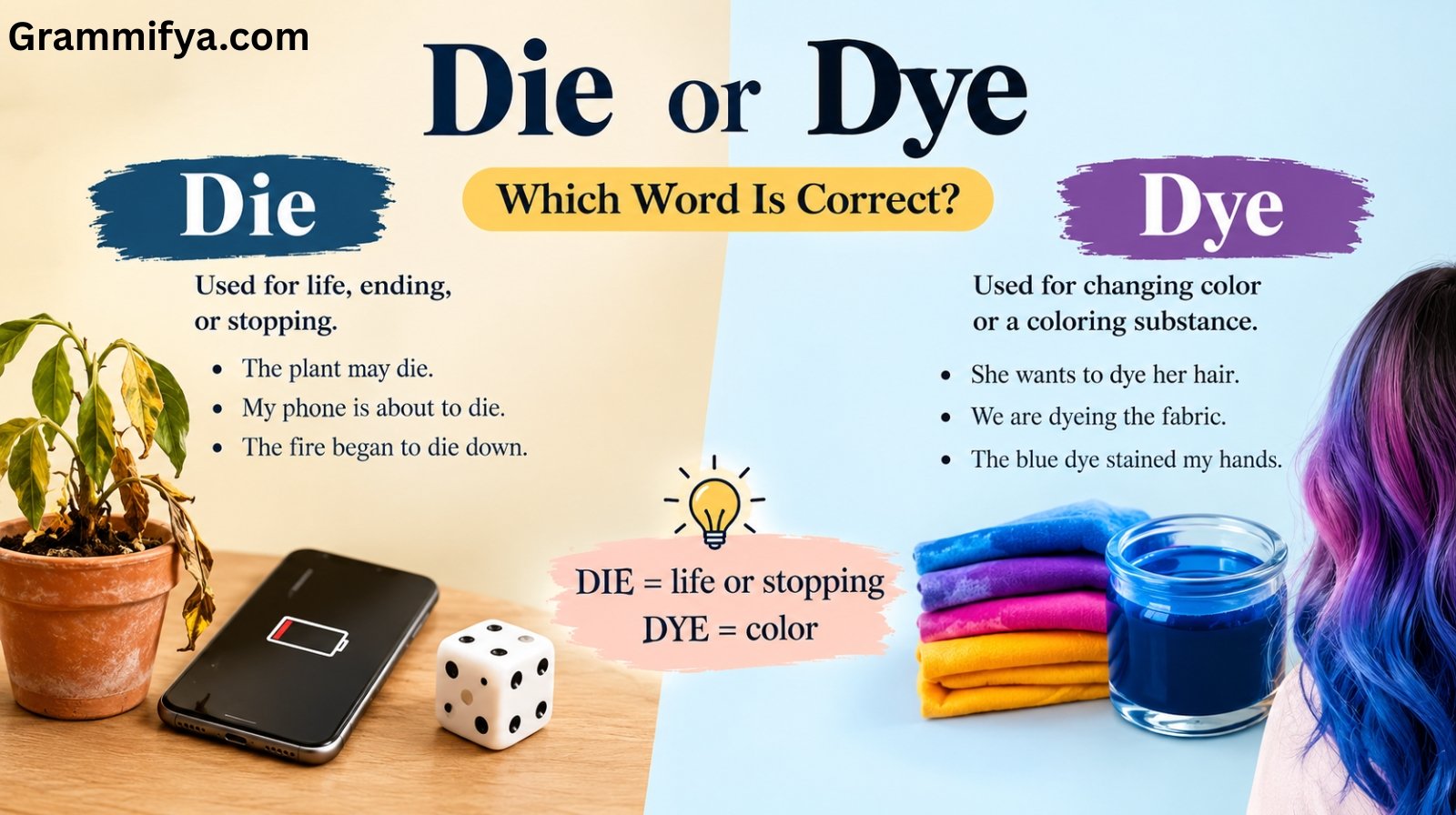
What Does “Die” Mean?
Die is mainly a verb meaning to stop being alive. It can also describe something stopping, ending, or no longer functioning.
For example:
- The flowers will die without water.
- His phone may die before he gets home.
- The old tradition could die out.
- The engine suddenly died.
Cambridge Dictionary defines die as stopping being alive and also notes that a machine, phone, or engine can “die” when it stops working.
What Does “Dye” Mean?
Dye is related to color. As a verb, it means to change the color of something. As a noun, it refers to the substance used to change a color.
Examples:
- She wants to dye her hair brown.
- We decided to dye the fabric blue.
- The artist used a natural dye.
- This dye produces a bright red color.
Cambridge Dictionary gives dye as both a verb and noun and defines it as changing the color of something or the substance used for that purpose.
Quick Difference Between Die and Dye
| Word | Main Meaning | Example |
|---|---|---|
| Die | To stop living or functioning | My phone may die soon. |
| Dye | To change something’s color | I want to dye my shirt blue. |
| Dying | The process of dying | The plant is dying. |
| Dyeing | The process of coloring something | She is dyeing her hair. |
| Died | Past tense of die | The plant died. |
| Dyed | Past tense of dye | She dyed her dress red. |
Easy rule: If the sentence is about life or something stopping, use die. If it is about color, use dye.
How to Know When to Use Die
The easiest way to understand die is to connect it with the idea of something ending, stopping, or losing life.
Die for Life and Living Things
Use die when something stops being alive.
For example:
- The tree may die without enough water.
- Many plants die during extreme heat.
- The animal eventually died.
- Some flowers die after only a few days.
Here, dye would be incorrect because there is no change of color involved.
Die for Things That Stop Working
English also uses die informally for machines and electronic devices that stop functioning.
For example:
- My laptop died during the meeting.
- My phone is about to die.
- The car engine suddenly died.
- The battery will die soon.
In these examples, die does not mean that the object was alive. It means that it stopped working. Cambridge also gives this use for phones and engines.
Die as a Noun
Die can also be a noun with meanings unrelated to death.
For example, in games, a die is one cube used to generate a random number. The plural is traditionally dice.
- Roll one die.
- Roll two dice.
The word die can also refer to a specialized tool or mold used to shape materials such as metal or plastic.
How to Know When to Use Dye
Use dye whenever you are talking about changing the color of something.
Dye as a Verb
When someone changes the color of hair, clothing, fabric, or another material, use dye.
Examples:
- I want to dye my hair black.
- She dyed her dress green.
- They are going to dye the fabric.
- He dyed his shoes a darker color.
The word can be used for many different types of coloring, not just hair.
Dye as a Noun
When you mean the actual substance used to add color, use dye as a noun.
Examples:
- The blue dye stained my hands.
- This fabric needs a stronger dye.
- The company produces natural dyes.
- She bought red dye for the project.
So remember:
Dye = color something or the substance used to color it.
Die vs. Dye in One Simple Example
Consider these two sentences:
My hair is dying.
This means the hair is losing life or vitality.
I am dyeing my hair.
This means you are changing your hair color.
The spelling changes the meaning completely.
Why Are Die and Dye So Easy to Confuse?
The biggest reason is pronunciation.
Die and Dye Sound the Same
Both die and dye are pronounced /daɪ/. Cambridge’s pronunciation entries confirm the same pronunciation for dye, while its die entry gives the same sound.
Because you cannot hear the spelling difference, you have to understand the meaning of the sentence.
For example, if someone says:
“I want to dye my hair.”
You know from the context that the person means change the color, so the correct spelling is dye.
A Simple Memory Trick
Here is an easy way to remember:
DYE = COLOR
Think of the Y in dye as reminding you of yellow, a color.
DIE = LIFE ENDS
If the sentence involves death, stopping, ending, or something no longer working, die is usually the word you need.
This simple association can help you avoid the spelling mistake.
Common Die and Dye Mistakes
Because these words sound identical, several mistakes are common.
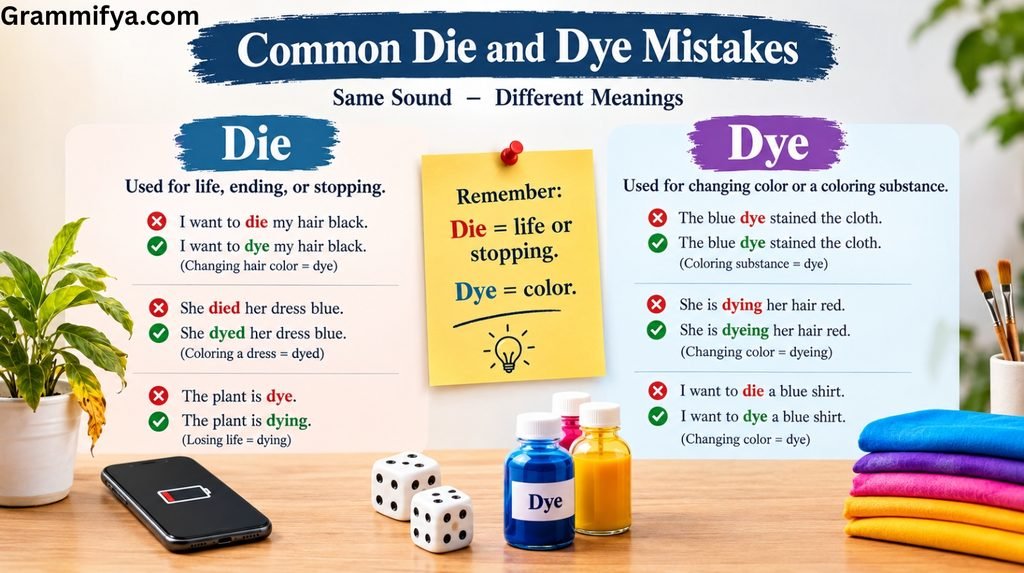
“Die My Hair” vs. “Dye My Hair”
❌ I want to die my hair black.
✅ I want to dye my hair black.
You are changing the color of your hair, so dye is correct.
“Died” vs. “Dyed”
❌ She died her dress blue.
✅ She dyed her dress blue.
The dress was colored, so the correct past tense is dyed.
Compare that with:
The plant died because nobody watered it.
Here, died is correct because the plant stopped living.
“Dying” vs. “Dyeing”
This is another especially confusing pair.
❌ She is dying her hair red.
✅ She is dyeing her hair red.
Here, she is changing her hair color, so dyeing is correct.
But:
The flowers are dying.
This means the flowers are losing life.
The extra e in dyeing helps distinguish the coloring action from dying.
A Real-Life Example: Dyeing Hair vs. a Dying Plant
Imagine Sarah is getting ready for a family celebration. She decides that she wants a new hairstyle, so she buys a box of dark brown hair dye. While preparing the bathroom, she notices that the small plant near her window looks unhealthy.
Sarah tells her friend, “I’m dyeing my hair tonight, but my plant is dying.”
Although the two words sound almost identical, their meanings are completely different.
Sarah is dyeing her hair because she wants to change its color. She is using a coloring product, so dyeing is the correct spelling. Meanwhile, the plant is dying because it is not getting what it needs to survive.
Later, Sarah says, “I dyed my hair brown.” Again, dyed is correct because the color has been changed.
If she said, “My plant dyed,” the meaning would be wrong. A plant does not dye simply because it stops living.
This example shows why pronunciation alone cannot help you choose between these words. Meaning and context are the real clues. When the sentence is about color, choose a form of dye. When it is about life ending or something stopping, choose a form of die.
2025–2026 Reference Data: What Current Dictionaries Confirm
A useful 2026 reference check shows that die and dye remain separate English dictionary entries with different meanings and grammatical uses.
- Die is listed as a verb meaning to stop being alive, with additional uses involving things such as machines stopping.
- Dye is listed as both a verb and noun connected with changing color.
- Both words are pronounced /daɪ/, which explains the spelling confusion.
- The present forms are die/dying and dye/dyeing, while their past forms are died and dyed.
This distinction is important because choosing the correct word cannot be based on sound alone. You need to look at what the sentence actually means.
Google’s current Search guidance also emphasizes helpful, reliable, people-first content and recommends using trustworthy sources and providing substantial value rather than simply rewriting existing material.
Die vs. Dye: A Quick Checklist
When you’re unsure which spelling to use, ask yourself these questions:
Step 1: Is the sentence about life ending?
If yes, use die.
The flowers may die.
Step 2: Is something stopping or no longer working?
If yes, die may be correct.
My phone might die.
Step 3: Is the sentence about changing color?
If yes, use dye.
She wants to dye her hair.
Step 4: Are you talking about a coloring substance?
Use dye.
The blue dye stained the fabric.
Step 5: Are you talking about one gaming cube?
Use die.
Roll one die.
This quick checklist can help you choose the correct word without memorizing complicated grammar rules.
Die or Dye: Examples in Everyday English
Here are some additional examples to make the difference easier to remember:
Die:
- The old tree could die without rain.
- My phone battery may die soon.
- The fire began to die down.
- The flowers died in the heat.
- Roll one die.
Dye:
- She wants to dye her hair blonde.
- He dyed his shirt black.
- The fabric was colored with natural dye.
- They are dyeing the curtains.
- The artist used several different dyes.
Notice the pattern: die connects with ending or stopping, while dye connects with color.
Mini Quiz: Die or Dye
1. Color or Life?
Which word belongs in this sentence?
“She wants to ____ her old jeans black.”
A) Die
B) Dye
C) Died
D) Dice
Answer: B) Dye — You use dye when you change the color of something.
2. Fill in the Blank
“The poor plant may ____ without water.”
A) dye
B) die
C) dyed
D) dyeing
Answer: B) die — A plant can die when it no longer lives.
3. Quick True or False
“Dye” can be used as a noun for a substance that adds color.
Answer: True — For example, The blue dye stained the fabric.
4. Pick the Correct Sentence
Which sentence is correct?
A) I want to die my hair blonde.
B) I want to dye my hair blonde.
C) I want to dyed my hair blonde.
D) I want to dying my hair blonde.
Answer: B) I want to dye my hair blonde. — Dye means to change the color of something.
5. Fill in the Blank
“The red ____ was used to color the fabric.”
A) die
B) died
C) dye
D) dying
Answer: C) dye — Here, dye is a noun meaning a coloring substance.
6. One Letter, Big Difference!
Which word completes the sentence?
“My phone might ____ before I get home.”
A) dye
B) die
C) dyed
D) dyeing
Answer: B) die — We can say a phone or battery dies when it loses power or stops working.
7. Dying or Dyeing?
Choose the correct word:
“She is ____ her hair for the wedding.”
A) dying
B) dyeing
C) died
D) die
Answer: B) dyeing — Dyeing means changing the color of something.
8. Spot the Meaning
Which sentence uses died correctly?
A) She died her shirt blue.
B) He died his hair black.
C) The flower died because nobody watered it.
D) They died the curtains red.
Answer: C) The flower died because nobody watered it. — Died is the past tense of die.
9. Fill in the Blank
“Last weekend, Sarah ____ her dress purple.”
A) died
B) die
C) dyed
D) dying
Answer: C) dyed — Dyed is the past tense of dye.
10. Which One Means “Color”?
If you’re talking about changing the color of your clothes, which word should you choose?
A) Die
B) Dye
C) Died
D) Dice
Answer: B) Dye — Remember: Dye = color.
11. Easy Grammar Check
Which sentence is written correctly?
A) The leaves are dyeing.
B) The leaves are dying.
C) The leaves are dyed because they need water.
D) The leaves are die.
Answer: B) The leaves are dying. — The leaves are losing life, so dying is correct.
12. Same Sound, Different Meaning
True or False:
“Die” and “dye” sound the same but have different meanings.
Answer: True — They are pronounced the same, but die relates to ending life or functioning, while dye relates to color.
13. Fill in the Blank
“We used natural ____ to give the cloth a beautiful blue color.”
A) die
B) died
C) dye
D) dying
Answer: C) dye — A dye is a substance used to add color.
14. Final Challenge: Can You Nail It?
Complete both sentences:
“The battery is about to ____.”
“She wants to ____ her hair.”
A) dye / die
B) die / dye
C) dyed / died
D) dying / dyeing
Answer: B) die / dye — A battery can die, while hair can be dyed to change its color.
Quick memory trick: 🧠 DIE = life or stopping. DYE = color.
FAQs
Is “die” or “dye” correct?
Both words are correct, but they have different meanings. Die generally relates to stopping life or functioning, while dye relates to changing color.
Is it “dye my hair” or “die my hair”?
The correct phrase is “dye my hair.” You use dye because you are changing the color of your hair.
What is the difference between dying and dyeing?
Dying comes from die and means the process of losing life. Dyeing comes from dye and means changing the color of something.
For example:
- The plant is dying.
- She is dyeing her hair.
Is “dyed” a word?
Yes. Dyed is the past tense and past participle of dye.
Example:
She dyed her hair red.
Is “died” a word?
Yes. Died is the past tense of die.
Example:
The plant died without water.
Is one die or one dye correct?
It depends on what you mean. One die means one gaming cube. One dye can mean one type or quantity of coloring substance.
For example:
Roll one die.
The artist used one blue dye.
Conclusion
So, die or dye which word is correct? The answer depends on the meaning.
Use die when you’re talking about something stopping, ending, losing life, or sometimes ceasing to work. Use dye when you’re talking about changing the color of something or the substance used to add color.
The easiest rule to remember is:
Die = life, ending, or stopping.
Dye = color.
And when you see dying and dyeing, remember that the first relates to die, while the second relates to dye.
If you often get confused by similar English words, keep exploring Gramvexa for clear explanations, useful examples, and simple grammar and spelling guides that make tricky English easier to understand.
Keep learning with more easy grammar lessons on Grammifya.
Authoritative References

Hi, I’m Muhammad Bilal, the creator of Grammifya. I’m passionate about making English grammar simple, practical, and easy to understand for learners of all levels. Through Grammifya, I share clear grammar guides, useful writing tips, and easy explanations to help students, writers, and English learners improve their communication skills.
My goal is to break down complex grammar rules into simple lessons that anyone can understand and apply in real-life writing. At Grammifya, I focus on providing accurate, helpful, and practical content to help you write better and communicate with confidence.