Have you ever written “make due” when you meant “make do”? You are not alone. Because do and due sound very similar in everyday speech, this is an easy mistake to make. However, “make do” is the standard and correct phrase when you mean managing with what you have, especially when your options are limited.
In this guide, you’ll learn the difference between make do or make due, what each word means, when to use make do, why make due causes confusion, and how to remember the correct expression.
The short answer is simple: Use “make do” when you mean “manage with what is available.”
What Does “Make Do” Mean?
Make do is an English idiom meaning to manage with whatever is available, even when it is not exactly what you want or need.
Cambridge Dictionary defines make do as managing without things you would like to have or managing with something of lower quality than you would prefer.
Make Do Meaning
The easiest way to understand make do is:
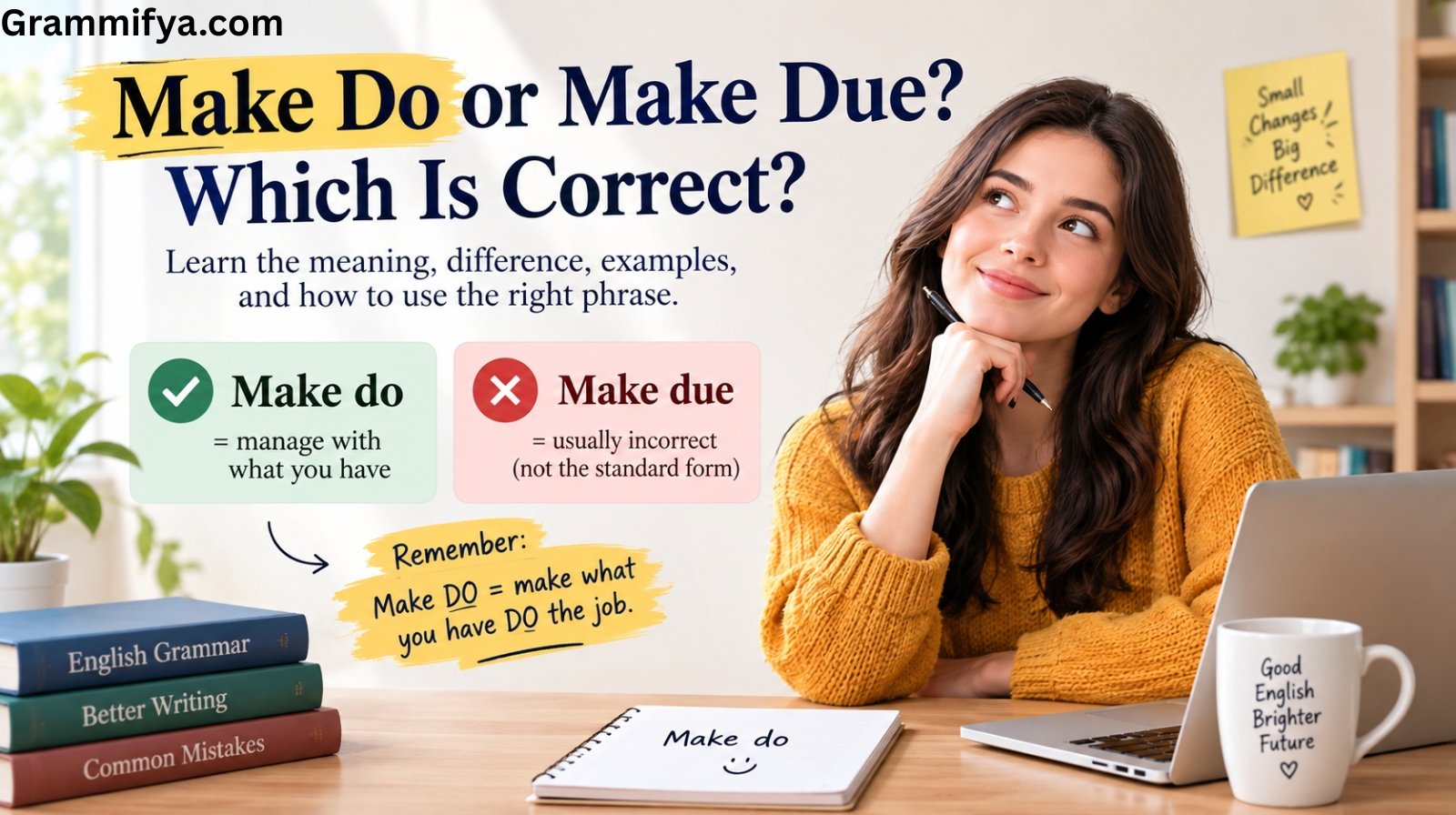
Make do = manage with what you have.
For example:
- We didn’t have enough chairs, so we made do with some boxes.
- I forgot my lunch, so I’ll make do with a sandwich from the vending machine.
- The hotel room wasn’t ideal, but we made do for one night.
- We couldn’t buy a new laptop, so we made do with the old one.
Notice that the phrase often appears as make do with something.
Why “Make Do” Is Correct
The word do works naturally in this idiom because the expression is about making something available work or serve a purpose despite limitations.
Make Do or Make Due: Which Is Correct?
If you are asking whether the correct expression is make do or make due, the answer is make do.
Make Do Is the Standard Phrase
Use make do when you have to accept what is available instead of getting something better or more suitable.
Examples:
- We don’t have a proper table, so we’ll make do with this desk.
- She forgot her umbrella and had to make do with a plastic bag.
- The store was closed, so we made do with what we already had.
- I can’t afford a new phone right now, so I’ll make do with my old one.
Is “Make Due” Correct?
In ordinary English, make due is generally not the standard form of the idiom.
When someone writes make due while intending to say “manage with what you have,” they are usually confusing the words do and due.
The confusion is understandable because the two words can sound similar, particularly in some varieties of English.
However, spelling should follow meaning, not just pronunciation.
A Quick Comparison
| Phrase | Meaning | Standard usage? | Example |
|---|---|---|---|
| make do | Manage with what is available | ✅ Yes | We’ll make do with this room. |
| make due | Usually an incorrect version of make do | ❌ Usually no | ❌ We’ll make due with this room. |
| due | Owed, expected, or scheduled | ✅ Yes | The payment is due Friday. |
Remember: If you mean “manage with what you have,” use “make do.”
When Should You Use “Make Do”?
The phrase make do is useful whenever someone has to cope with an imperfect situation or use an alternative because the preferred option is unavailable.
Use “Make Do With” for Limited Resources
This is probably the most common pattern:
make do with + noun
Examples:
- We had no chairs, so we made do with cushions.
- I forgot my charger, so I’ll make do with my power bank.
- There wasn’t any fresh bread, so we made do with crackers.
- The printer stopped working, so the office made do with digital copies.
Use “Make Do” Without “With”
You can also use make do by itself when the object is already understood.
“Make Do” in Everyday English
You can use the phrase in conversations, stories, emails, articles, and many other forms of writing.
Why Do People Write “Make Due” Instead?
The main reason is pronunciation.
“Do” and “Due” Can Sound Similar
In many accents, do and due can sound very similar or even identical in everyday speech.
That creates a classic spelling problem: someone knows the phrase from hearing it but has never seen it written.
The Meaning of “Due” Is Different
The word due has several legitimate meanings, but they are not the meaning intended in the idiom make do.
For example:
- The rent is due tomorrow.
- The train is due at 8:30.
- She received her due reward.
- The money is due to the company.
A Simple Memory Trick
Think:
Make DO = make something DO the job.
If you don’t have exactly what you need, you find something else and make it do the job.
Make Do vs. Make Due: Examples You Can Remember
Seeing the two forms side by side makes the difference much easier to understand.
Correct Examples With “Make Do”
- We didn’t have enough money, so we made do with what we had.
- The hotel was full, so we had to make do with a smaller room.
- I forgot my notebook, so I made do with a sheet of paper.
- There was no internet, so we made do with our phones.
- The kitchen was being renovated, so we made do with a microwave.
Incorrect Examples With “Make Due”
- ❌ We had to make due with an old computer.
- ❌ She made due with the ingredients available.
- ❌ We’ll make due until the new equipment arrives.
Correct them to:
- ✅ We had to make do with an old computer.
- ✅ She made do with the ingredients available.
- ✅ We’ll make do until the new equipment arrives.
Real-Life Example: Making Do When Plans Change
Imagine that you are organizing a small family gathering at home. You expect twelve guests, but you only have eight dining chairs. Buying new furniture isn’t practical because the gathering is only one evening.
Instead of canceling the event, you look around the house. You find two office chairs, a couple of sturdy stools, and a small bench. They aren’t a perfect match, but everyone can sit comfortably enough.
You could say:
“We didn’t have enough dining chairs, so we made do with the stools and bench.”
This is exactly how make do works in real-life English. You have a problem, but you use the resources available to solve it.
The phrase doesn’t necessarily mean that the situation is terrible. It simply suggests that the available option isn’t exactly what you wanted, but it is good enough for the situation.
The same idea applies to work, travel, cooking, studying, shopping, and everyday problems. You might make do with an old laptop until you can afford a new one. You might make do with leftovers when you don’t have time to cook. You might make do with a phone hotspot when the Wi-Fi is unavailable.
In all these situations, make do communicates flexibility and practical problem-solving.
What Current Language Data Tells Us
There isn’t a reliable annual statistic from major dictionaries showing exactly how many people incorrectly write “make due.” Therefore, it would be misleading to invent a percentage or claim that a certain share of writers make this mistake.
However, there is useful current data about the broader online language environment.
A 2026 Pew Research Center analysis examined 490,000 English-language webpages sampled from Common Crawl between January 2021 and July 2026. The study found that about 10% of the webpages in its July 2026 sample showed significant signs of AI authorship, while more than one-third of pages published after ChatGPT’s release showed such signs.
This reinforces the importance of checking language against authoritative dictionaries rather than relying only on what appears frequently online.
For make do, major learner dictionaries provide clear support for the standard idiom. Cambridge defines it as managing with things that are not what you would ideally have, while Oxford similarly defines it as managing with something that isn’t really good enough.
A Quick Checklist: Should You Use “Make Do” or “Make Due”?
Ask What You Mean
Do you mean “manage with what is available”?
→ Use make do. ✅
Do you mean that something is owed or expected?
→ Use due in the appropriate expression. ✅
Check Your Sentence
| If you want to say… | Use… | Example |
|---|---|---|
| Manage with what you have | make do | We’ll make do with this. |
| Use an imperfect substitute | make do with | She made do with an old phone. |
| Something is owed | due | The payment is due today. |
| Something is expected to happen | due | The train is due at noon. |
| Something is appropriate or deserved | due | He received his due recognition. |
The One-Second Test
If you can replace the phrase with “manage” or “get by,” you almost certainly need:
make do
For example:
“We’ll have to make do with the old printer.”
You can understand this as:
“We’ll have to manage with the old printer.”
That confirms the correct phrase.
Mini Quiz: Make Do or Make Due
1. Pick the Correct Phrase
Which phrase means “manage with what you have”?
A) Make due
B) Make do
C) Made due
D) Making due
Answer: B) Make do
2. Fill in the Blank
We didn’t have enough chairs, so we had to ______ with stools.
Answer: make do
3. Quick Choice
Which sentence is correct?
A) We made due with the old computer.
B) We make due with the old computer.
C) We made do with the old computer.
D) We made doing with the old computer.
Answer: C) We made do with the old computer.
4. What Does It Mean?
What does “make do” mean?
A) Buy something new
B) Give something away
C) Manage with what is available
D) Make something expensive
Answer: C) Manage with what is available
5. Fill in the Blank
I forgot my charger, so I’ll ______ with my power bank.
Answer: make do
6. Spot the Mistake
Which sentence contains the incorrect form?
A) We’ll make do with this table.
B) She made do with her old phone.
C) They had to make due with fewer chairs.
D) I can make do until tomorrow.
Answer: C) They had to make due with fewer chairs.
The correct sentence is: They had to make do with fewer chairs.
7. Do or Due?
Choose the word that completes the sentence:
“We don’t have a proper desk, so we’ll make ______ with this table.”
A) do
B) due
Answer: A) do
8. Fill in the Blank
If something isn’t ideal but you can still manage with it, you can ______
Answer: make do
9. Which One Is About Money?
Which sentence uses due correctly?
A) We made due with an old laptop.
B) The payment is due tomorrow.
C) We due make with our old laptop.
D) She made due with fewer chairs.
Answer: B) The payment is due tomorrow.
10. True or False?
“Make do” means to manage with something that is available, even if it isn’t ideal.
Answer: True
11. Choose the Natural Sentence
Which sentence sounds correct in standard English?
A) We had to make due with what we had.
B) We had to make do with what we had.
C) We had to make doing with what we had.
D) We had to make did with what we had.
Answer: B) We had to make do with what we had.
12. Fill in the Blank
There was no fresh bread, so we had to make ______ with crackers.
Answer: do
13. Can You Catch the Confusion?
Why do people sometimes write “make due” instead of “make do”?
A) The words have completely different pronunciations.
B) “Due” is always more formal than “do.”
C) “Do” and “due” can sound very similar in speech.
D) “Make due” is the preferred American spelling.
Answer: C) “Do” and “due” can sound very similar in speech.
14. The Final Challenge
Which sentence correctly uses make do?
A) The train is make do at six.
B) The payment will make do tomorrow.
C) We couldn’t buy new furniture, so we made do with what we had.
D) Her bill is make do next week.
Answer: C) We couldn’t buy new furniture, so we made do with what we had.
Easy rule to remember: 👉 Make DO = make what you have DO the job.
FAQs
Is “make do” or “make due” correct?
Make do is the standard phrase when you mean “manage with what is available.” Make due is generally a mistaken spelling of this idiom.
What does “make do” mean?
Make do means to manage with something that is available even though it may not be exactly what you want or need.
Is “make due” ever correct?
If you intend the common idiom meaning “manage with what you have,” make due is not the standard form. Use make do instead.
How do you use “make do” in a sentence?
The most common structure is make do with + noun.
For example:
“We didn’t have enough chairs, so we made do with stools.”
Why do people confuse “make do” and “make due”?
The words can sound very similar in speech. Because people often learn expressions by hearing them before seeing them written, they may choose due when they actually need do.
What is an easy way to remember “make do”?
Remember:
Make DO = make what you have DO the job.
If you are coping with limited resources, choose make do.
Conclusion
So, make do or make due which is correct?
The answer is make do when you mean to manage with what you have, especially when the available option isn’t ideal.
Use:
✅ We had to make do with the old computer.
Not:
❌ We had to make due with the old computer.
The confusion mainly comes from the similar pronunciation of do and due. But once you connect make do with the idea of making something work, the correct spelling becomes much easier to remember.
The next time you find yourself wondering whether it’s make do or make due, remember one simple rule:
If you mean “manage with what you have,” make do.
Want to avoid more common English spelling and grammar mistakes? Explore more helpful word comparisons and grammar guides on Gramvexa and make your everyday English clearer and more confident.
Keep learning with more easy grammar lessons on Grammifya.
Authoritative References

Hi, I’m Muhammad Bilal, the creator of Grammifya. I’m passionate about making English grammar simple, practical, and easy to understand for learners of all levels. Through Grammifya, I share clear grammar guides, useful writing tips, and easy explanations to help students, writers, and English learners improve their communication skills.
My goal is to break down complex grammar rules into simple lessons that anyone can understand and apply in real-life writing. At Grammifya, I focus on providing accurate, helpful, and practical content to help you write better and communicate with confidence.